
Illuminating the Past
How One Student Bridges Early Modern Drama and Contemporary Design
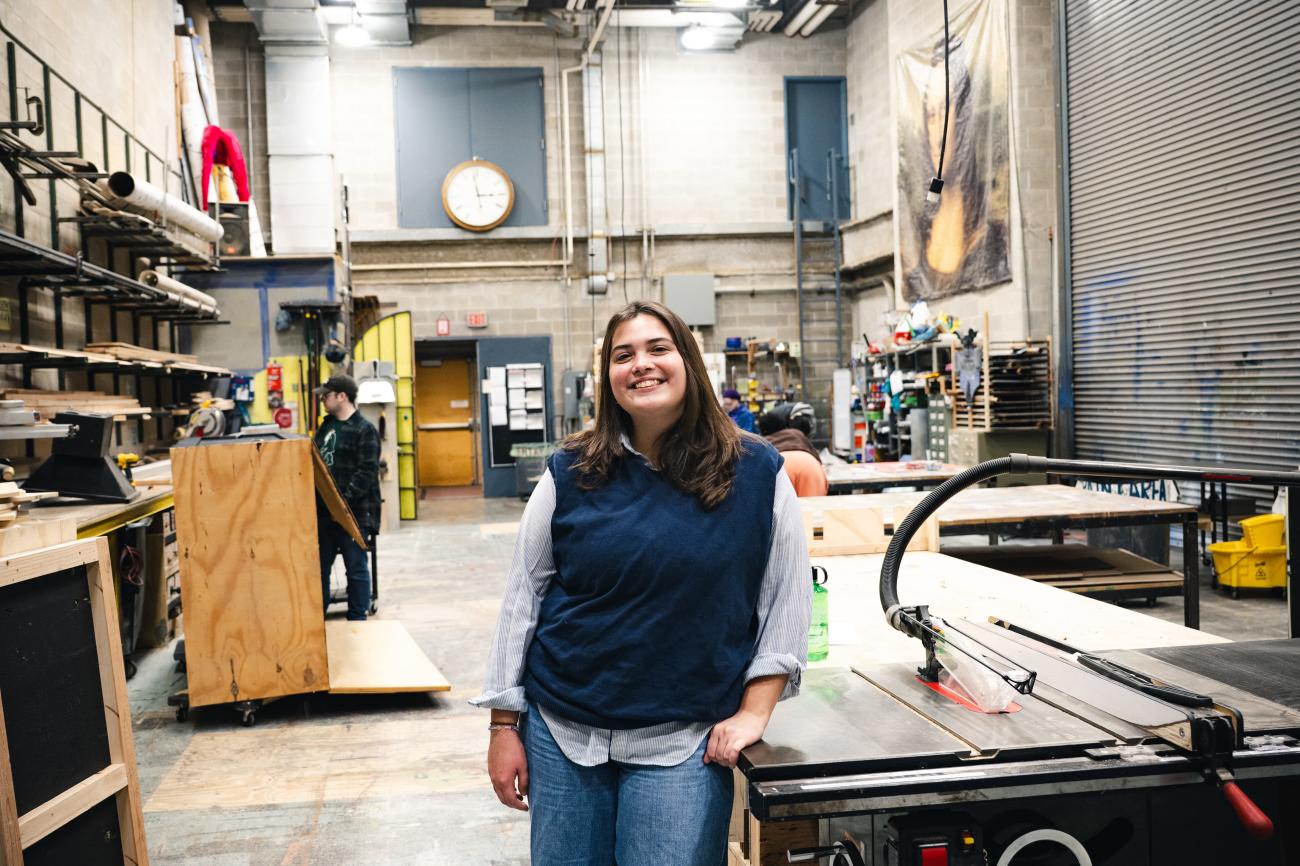
When Avery McGarry returned from England last November, she brought back more than memories of seeing six theatrical productions — she returned with a deepened understanding of how centuries-old texts continue to speak to contemporary audiences through innovative staging and design.
McGarry, a double major in English and theatre, spent time immersed in Britain's theatrical landscape, attending performances at Shakespeare's Globe, the National Theatre and the Royal Shakespeare Company in Stratford-upon-Avon. The experience has become central to her senior thesis, which examines how modern productions of early modern plays use staging and design to illustrate themes of queerness that exist within the original texts.
"These were contemporary productions, using the original text but adding modern spins on them too," says McGarry, who is also an Eckardt Scholar. "The plan for my thesis is to show how staging illustrates themes in the original texts that aren't visible to someone if they're just reading the script. I'm looking at their staging in a very particular way, specifically how themes of queerness are illuminated."
McGarry's thesis takes a multi-tiered approach that showcases both her analytical and creative skills. The first section provides historical context about theatre in the early modern period. The second section offers detailed textual analysis of "Twelfth Night," drawing on two productions McGarry attended, one at Shakespeare in the Park in New York's Delacorte Theatre and another at the Globe in London.
The final component is perhaps the most ambitious. McGarry plans to propose her own scenic design and staging for "The Roaring Girl," a Jacobean period play by Thomas Middleton and Thomas Dekker. Written around 1610, the play centers on Moll Cutpurse, a cross-dressing figure based on the real-life Mary Frith, who was notorious in early modern London for wearing men's clothing and living outside conventional gender norms. McGarry's design work will potentially include a scale model created in consultation with theatre department scene design faculty Melpomene Katakalos and Will Lowry.

"I want to bridge the gap and show how all of these things connect," McGarry explains. "It's not just about understanding what was done historically or what contemporary directors are doing, it's about using that knowledge to create something new."
McGarry's journey to this interdisciplinary thesis began unexpectedly. Originally a journalism major, she discovered her passion for English literature through coursework, particularly a seminar on Gender and Sexuality in Early Modern Poetry with English Professor Jenna Lay.
Being an active member of the theatre department has reinforced McGarry's belief in collaborative artistic practice. "The limits of how I read something are extremely limited," McGarry acknowledges. "By collaborating with directors and other designers, not just being in my own world, is what really makes people understand things to a deeper level."
McGarry will remain at Lehigh after graduating in May for an apprenticeship year with the theatre department, continuing to design, assist with teaching and strengthen her portfolio before pursuing an MFA in scenic design.